
Project: Coin-FLip
Some decisions feel bigger than they are—what to eat, what to watch, which task to start, which idea to pitch. But when your brain spins on repeat, even “small” choices can feel exhausting.
Indecision usually isn’t a lack of intelligence. It’s often a mix of too many options, fear of regret, and the mental load of trying to pick the “best” outcome with limited information.
The good news: you don’t need perfect clarity to move forward. A few simple tricks can reduce decision stress, speed up your choices, and help you feel confident about what you picked.
Why deciding can feel so hard (even for easy stuff)
If you can’t decide, you’re not broken—you’re human. Modern life pushes endless options, and your brain tries to protect you from making a “wrong” move.
- Decision fatigue: the more choices you make, the worse your judgment feels later in the day.
- Maximizing vs. satisficing: “What’s best?” takes longer than “What’s good enough?”
- Regret avoidance: you delay choosing to avoid imagining disappointment.
- Too many variables: when criteria aren’t clear, every option seems equally risky.
Quick ways to choose faster (without overthinking)
These are practical decision-making shortcuts you can use immediately—especially when the stakes are low to medium.
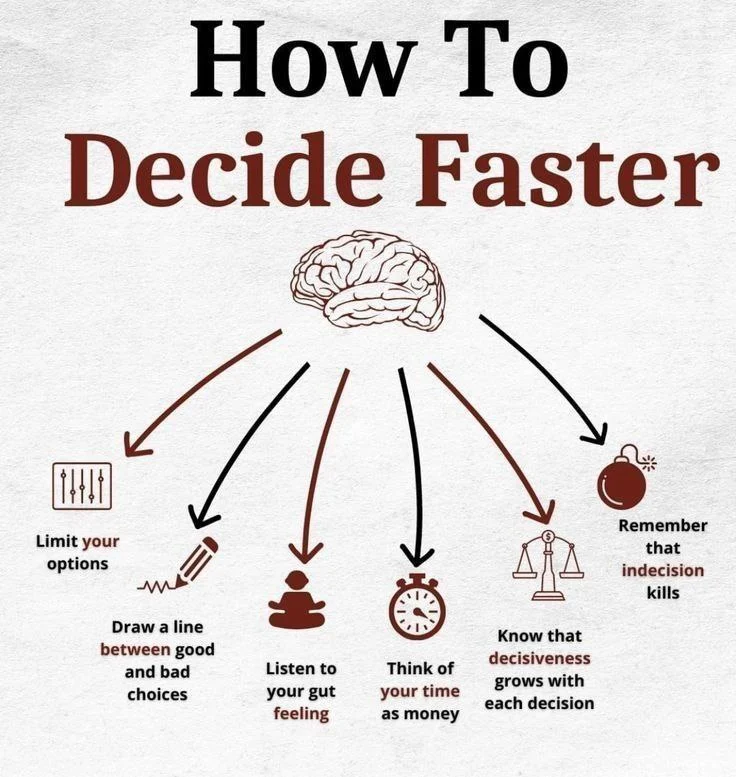
1) Shrink the menu
Give yourself fewer options on purpose. Constraints create clarity.
- Pick your top 3 options and ignore the rest.
- Set a 2-minute timer for everyday choices (food, playlists, outfits).
- Use rules like “under $30,” “within 20 minutes,” or “must solve today’s problem.”
2) Decide what matters most (one priority only)
Many people stall because they’re trying to optimize for everything. Choose a single “north star” for this decision.
- If it’s a purchase: durability or price?
- If it’s a plan: rest or productivity?
- If it’s a career move: learning or stability?
3) Use the “future you” test
Ask: “In two weeks, what will I wish I had done?” This reframes the choice away from today’s anxiety and toward likely outcomes.
When two options are equal, make it simple
Sometimes the truth is that either choice works. When the difference is minor, you’re allowed to pick a tiebreaker and move on.
If you genuinely feel stuck between two reasonable options, a neutral nudge can break the loop—like writing each choice on paper or even using a tool to flip a coin online as a fast tiebreaker (and noticing which result you secretly hoped for).
Tip: If you feel disappointed by the outcome, that’s useful data—you just learned what you actually wanted.
How to make decisions you won’t second-guess
Confidence often comes after you commit, not before. Try this simple process to reduce “what if” spirals.
- Write the decision in one sentence. (Clarity reduces anxiety.)
- Name your reason. One line is enough: “I chose X because it saves time.”
- Set a review point. “I’ll reassess in 30 days.” This makes choices feel reversible.
- Close the tab. Stop researching once you’ve met your criteria.
FAQs
Q: What if I keep replaying the decision after I choose?
A: Give your brain closure: write down why you chose it, then set a specific time to review (if needed). If the choice is low-stakes, treat second-guessing as noise, not a signal.
Q: How do I make choices when I’m stressed or tired?
A: Use defaults and routines. Decide earlier in the day, limit options to two or three, and rely on simple rules like “pick the fastest healthy meal” or “start with the smallest task.”
Q: Is it bad to use random methods for decisions?
A: For high-stakes choices, you want deliberate criteria. But for equal or low-stakes options, randomness can be a practical tiebreaker—and your emotional reaction to the result often reveals your preference.
Conclusion
When you can’t decide, the goal isn’t to find a perfect answer—it’s to choose a solid option with less stress. Reduce your choices, pick one priority, and commit with a simple review point so you can move forward.
The more you practice quick, values-based decisions, the easier it gets to trust yourself—and the less time you’ll spend stuck between “maybe” and “what if.”