
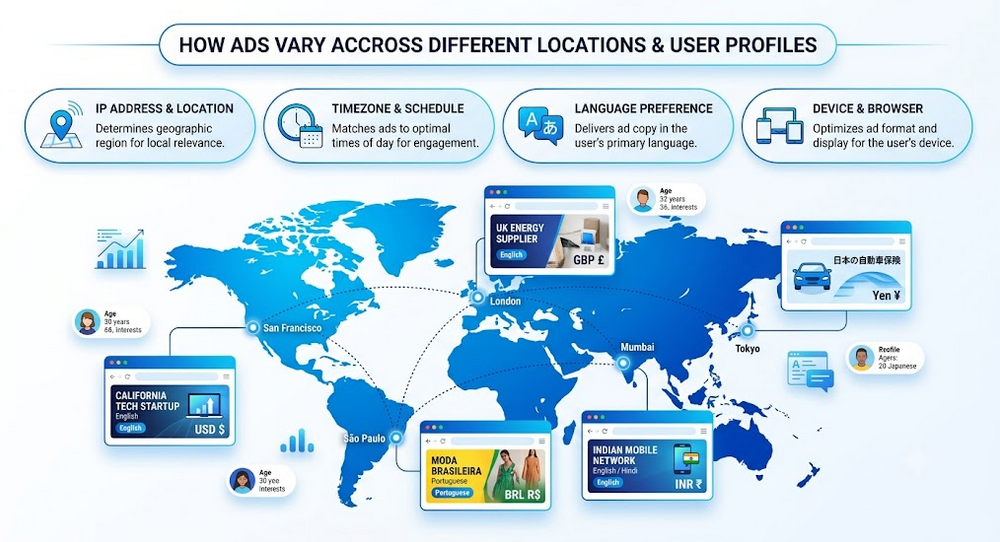
Digital advertising has evolved into one of the most data-driven industries in the world. Every advertising impression, click, conversion, and audience interaction contributes to increasingly sophisticated optimization systems powered by machine learning. While these technologies enable advertisers to reach highly relevant audiences, they also introduce a significant challenge: marketers often struggle to observe their own campaigns objectively.
Today, the advertisements shown to one person may differ substantially from those shown to another—even if both users search for the same keyword from the same city. Search engines, social media platforms, retail marketplaces, and video services continuously personalize advertising based on browser identity, device characteristics, behavioral history, geographic location, language preferences, and numerous other contextual signals.
As a result, ad verification has become far more than confirming whether an advertisement is displayed. It is now a comprehensive process of validating campaign quality, measuring delivery accuracy, evaluating compliance, and collecting unbiased competitive intelligence across diverse digital environments.
What Ad Verification Really Means
Modern ad verification combines several independent disciplines into a single quality assurance process.
Organizations typically evaluate:
- Advertisement visibility (viewability)
- Geographic targeting accuracy
- Creative rendering consistency
- Brand safety
- Invalid traffic (IVT) detection
- Fraud prevention
- Landing page functionality
- Policy compliance
- Audience targeting validation
- Regional legal requirements
Each component influences campaign performance and ultimately affects return on advertising spend (ROAS).
For global organizations running campaigns across dozens of markets, even small configuration errors can result in wasted advertising budgets, inconsistent messaging, or regulatory compliance issues.
The Hidden Challenge: Personalized Advertising
One of the least understood aspects of digital advertising is personalization bias.
Modern advertising platforms—including Google, Meta, TikTok, Amazon, LinkedIn, and numerous programmatic exchanges—rarely display identical advertisements to every visitor.
Instead, delivery systems evaluate a broad collection of contextual information, including:
- Previous browsing activity
- Search history
- Purchase behavior
- Geographic location
- Language settings
- Device type
- Browser fingerprint
- Historical engagement
- Time of day
- Audience segmentation
- Account reputation
- Machine learning predictions
These factors influence which advertisements appear, where they appear, and how frequently they are shown.
Consequently, marketing teams observing campaigns from a single office computer often receive only one personalized perspective rather than an objective representation of campaign delivery.
This phenomenon introduces what many analysts describe as measurement bias—the difference between what internal teams observe and what real users actually experience.
Why Independent Observation Matters
Reliable campaign analysis requires separating measurement from personalization.
For example, an international retailer may wish to verify whether:
- Seasonal promotions appear correctly in multiple countries.
- Local currencies display accurately.
- Region-specific pricing functions as intended.
- Language localization is complete.
- Legal disclaimers satisfy local regulations.
- Promotional creatives rotate according to campaign schedules.
Performing these checks from a single browser profile provides only limited visibility because platforms continue adapting results based on that browser’s accumulated history.
Independent browser environments provide a more representative sample of how campaigns appear across different audiences.
Antidetect Browsers as Browser Identity Management Platforms
Antidetect browsers are frequently described as privacy tools, but in professional marketing environments they serve a broader purpose.
Their primary function is browser identity management.
Each browser profile represents an independent environment with its own persistent configuration, including:
- Browser fingerprint
- Cookies
- Cache
- Local storage
- Authentication sessions
- Browser extensions
- User-Agent
- Screen resolution
- Language preferences
- Time zone
- Geolocation settings
- Proxy configuration
Rather than constantly changing browser attributes, professional implementations emphasize internally consistent browser identities that resemble genuine devices.
This consistency is increasingly important because modern fraud detection systems evaluate relationships between multiple browser characteristics instead of relying on isolated signals.
Competitive Intelligence Without Historical Bias
Competitive intelligence has become another major application for isolated browser environments.
Marketing teams routinely monitor:
- Competitor advertising creatives
- Promotional messaging
- Seasonal offers
- Landing page variations
- Product pricing
- Search advertisements
- Sponsored listings
- Regional campaigns
- Display advertising
- Video advertising
Because personalization influences which advertisements appear, isolated browser profiles help reduce historical bias during observation.
For example, organizations can compare campaign visibility across multiple geographic markets while maintaining independent browser identities for each testing environment.
This creates more reliable datasets for strategic analysis and campaign planning.
Geographic Verification at Enterprise Scale
International organizations frequently launch campaigns simultaneously across numerous countries.
Quality assurance teams may need to validate:
- Currency formatting
- Date formats
- Local payment methods
- Language localization
- Regional promotions
- Cookie consent banners
- GDPR compliance
- CCPA notices
- Product availability
- Shipping information
Maintaining dedicated browser profiles for individual markets allows organizations to conduct these checks more efficiently than repeatedly reconfiguring a single browser.
Many enterprise workflows therefore assign one persistent browser profile to each geographic region under continuous testing.
The Importance of Session Integrity
Creating multiple browser profiles alone is not sufficient.
Modern detection systems evaluate the internal consistency of every browsing environment.
For example, a browser configured with:
- French language preferences
- Paris time zone
- European keyboard layout
- French currency formatting
should not unexpectedly connect through an IP address located thousands of kilometers away unless there is a legitimate explanation.
Similarly, browser fingerprint characteristics should align naturally with the reported operating system, graphics hardware, display capabilities, and browser version.
Maintaining this internal consistency is commonly referred to as session integrity.
The more coherent the browser environment appears, the more accurately it represents realistic user conditions for testing purposes.
Beyond Browser Fingerprinting
Although browser fingerprinting receives significant attention, it represents only one component of modern platform intelligence.
Advertising platforms increasingly combine fingerprint information with broader indicators, including:
- Device reputation
- IP reputation
- Historical authentication
- Network quality
- Session duration
- User interaction patterns
- Navigation behavior
- Login frequency
- Geographic stability
- Browser persistence
Artificial intelligence models evaluate these signals collectively to estimate confidence in user identity and traffic quality.
Consequently, accurate ad verification depends on realistic browser environments rather than isolated fingerprint modification.
Reliable Data Requires High-Quality Observation
Successful marketing decisions depend on reliable data.
If measurement itself becomes distorted by personalization, optimization efforts may target incorrect assumptions instead of actual customer experiences.
Organizations increasingly recognize the importance of collecting first-party observational data—measurements obtained from controlled browser environments specifically designed to minimize unnecessary personalization effects.
This approach supports more informed decisions regarding media buying, localization, creative optimization, and campaign budgeting.
Learning Through Independent Technical Resources
Because browser identity technologies evolve continuously, many professionals rely on independent educational resources to understand current implementation practices.
Analytical platforms such as antidetect.org publish technical articles explaining browser fingerprinting, browser profile architecture, proxy integration, WebRTC behavior, browser isolation techniques, detection methodologies, and comparative evaluations of antidetect browser solutions.
These resources help marketers, QA engineers, cybersecurity researchers, and software developers better understand the technical principles underlying browser identity management while distinguishing independently verifiable concepts from vendor-specific marketing claims.
Looking Ahead
Artificial intelligence is transforming both digital advertising and the systems used to measure it. Campaign delivery, audience segmentation, fraud detection, personalization, and bidding strategies are increasingly driven by machine learning models that continuously adapt to new data.
In this environment, objective observation becomes increasingly valuable.
Anti-detect browsers should therefore be viewed not simply as privacy tools, but as infrastructure for structured browser identity management that supports legitimate advertising verification, competitive research, localization testing, and quality assurance.
Organizations that combine consistent browser environments with rigorous measurement practices, reliable proxy infrastructure, and ongoing education about browser identity technologies are better positioned to make evidence-based marketing decisions.
As personalization algorithms become more sophisticated, the ability to observe digital experiences from multiple independent perspectives will continue to grow in strategic importance. Accurate, unbiased data remains one of the most valuable assets in modern advertising, and maintaining high-quality observation environments is becoming an essential capability for teams operating at enterprise scale.