
Introduction
The Rolex Daytona is one of the most recognizable chronographs in the world, known for its sporty appearance, balanced dial, and strong connection with motorsport culture. Because genuine models can be difficult to obtain and command very high prices, the term “rolex daytona super clone” is often used online to describe high-grade replicas designed to closely resemble the original watch. For anyone researching the subject, it is important to understand what these watches are, how replica manufacturers try to reproduce the visual details of a luxury chronograph, and where the differences from an authentic Rolex remain. A Rolex Super Clone may imitate features such as the Daytona-style case, tachymeter bezel, three-register dial, bracelet design, and automatic movement appearance, but visual similarity does not make a replica an authentic Rolex. The distinction matters for buyers who are interested in watches as collectibles, fashion accessories, or examples of replica manufacturing. Looking closely at construction also provides a better understanding of why some replicas appear more convincing than others. Common terms connected with this market include Rolex Daytona replica, Daytona-style chronograph, luxury watch replica, automatic replica movement, ceramic bezel, sapphire-style crystal, stainless steel watch case, and replica watch craftsmanship. These terms describe different aspects of the product category rather than proving authenticity or quality. A careful approach therefore focuses on observable design characteristics, movement technology, materials, finishing, and overall construction instead of relying only on marketing claims. This article examines those areas in a straightforward way so readers can better understand the design language associated with the Rolex Daytona and the characteristics commonly found in high-grade replica versions.
Daytona-Inspired Case and Bezel Design
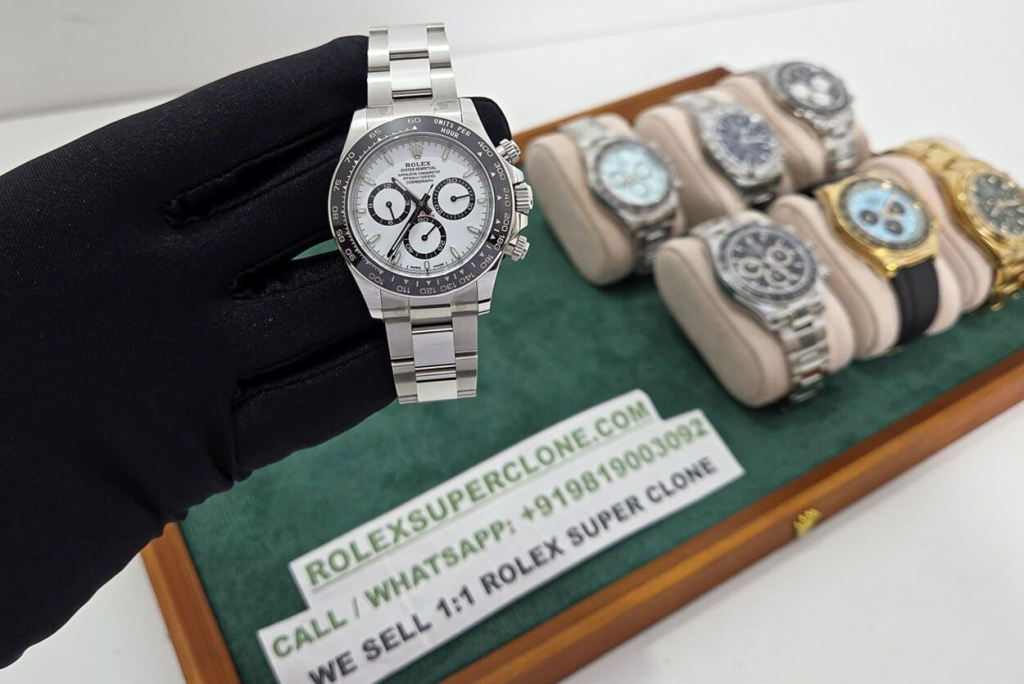
One of the first details people notice on a Daytona-style watch is its case and bezel. The classic design combines a rounded case profile with integrated-looking lugs and a sporty chronograph layout, giving the watch a distinctive appearance that works with both casual and formal clothing. Replica manufacturers commonly pay close attention to proportions because even small changes in case thickness, lug shape, crown placement, or bezel dimensions can make a watch look noticeably different from the reference design. A rolex daytona super clone is generally marketed around this attention to external appearance, with manufacturers attempting to reproduce the visual balance of the original model. The bezel is another major design element, particularly on versions inspired by Daytona models that use a dark ceramic-style bezel with a tachymeter scale. A properly executed bezel can create a sharp contrast with the dial and case while giving the chronograph its recognizable racing-inspired character. However, materials and finishing can vary considerably between replica watches. Some may use ceramic components, while others rely on alternative materials that are finished to resemble ceramic. The same applies to the case, which may be made from different grades of stainless steel depending on the manufacturer and price category. Surface finishing can include polished and brushed sections intended to reproduce the transitions seen on luxury watches. These details demonstrate why looking beyond photographs is important. Lighting, camera angles, and digital editing can make a replica appear closer to an authentic watch than it may be in person. Examining case edges, bezel markings, crown guards, pushers, bracelet connections, and finishing under normal lighting provides a more realistic view of construction quality.
Dial Layout and Chronograph Details
The dial is another important part of the Daytona-inspired design because it combines several visual elements into a relatively compact space. A traditional Daytona-style chronograph typically features three sub-dials arranged around the center of the watch, along with applied hour markers and carefully positioned text. Replica makers attempt to reproduce these proportions because sub-dial spacing and hand placement strongly influence the overall appearance. A rolex daytona super clone may therefore be designed with a dial that closely follows the layout of a particular Daytona reference, including contrasting sub-dials, metallic markers, and a central chronograph hand. The quality of printing is especially noticeable on a detailed dial. Authentic luxury watches generally use highly controlled production processes to create consistent lettering, scales, markers, and applied elements. Replicas can sometimes reproduce these features impressively, but small differences may remain in font weight, spacing, marker alignment, or the finish of the hands. The chronograph registers also deserve attention. Their position, size, and depth affect how the dial looks from different angles. Some replica movements are built to imitate the functions and visual behavior associated with a genuine chronograph, while others prioritize exterior appearance. This is an important distinction because a watch can look very convincing while using an entirely different internal mechanism. Sapphire-style crystal is also frequently mentioned in replica descriptions because the crystal affects both clarity and durability. Some higher-grade replicas use synthetic sapphire, while others use mineral or alternative crystal materials. Readers should not assume that the word “sapphire” in an online listing automatically confirms a specific material. Independent verification is more reliable when material quality is an important consideration.
Movement Technology and Mechanical Construction
The movement is where the differences between a genuine Rolex and a replica can become especially significant. A mechanical watch movement contains numerous precisely manufactured components, and high-end Swiss movements are developed through extensive engineering, testing, and quality-control processes. Replica manufacturers use a range of automatic movements, some designed specifically for replica watches and others adapted from widely available mechanical platforms. A rolex daytona super clone may therefore be advertised with an automatic chronograph movement intended to imitate certain functions or visual characteristics of a genuine Daytona movement. Movement terminology can sometimes be confusing because sellers may use names such as “super clone movement” without providing enough technical information to verify what is actually inside the case. Buyers researching this category should distinguish between the movement’s stated specifications and independently confirmed performance. Important considerations include chronograph operation, power reserve, winding behavior, timekeeping stability, serviceability, and the availability of replacement components. Genuine Rolex movements are manufactured to the brand’s own specifications and undergo extensive testing, while replica movements can differ greatly from one manufacturer to another. Some may offer reasonable everyday performance, whereas others can have limitations in accuracy, durability, or repair support. Water resistance is another area where caution is useful. A listing may claim a certain level of resistance, but a replica should not automatically be treated as equivalent to an authentic watch that has undergone professional pressure testing. Seals, crown construction, case assembly, and crystal installation all affect resistance. Anyone handling a mechanical replica should therefore avoid assuming that advertised specifications have been independently verified.
Bracelet, Clasp, and Finishing Quality
The bracelet plays a major role in how a Daytona-style watch feels and looks when worn. A well-finished bracelet has properly shaped links, smooth transitions, consistent surfaces, and a clasp that opens and closes with a controlled action. Replica manufacturers often try to reproduce the familiar three-link appearance associated with Daytona models, including combinations of polished and brushed surfaces. On a higher-grade replica, the external finishing may look refined at first glance, but close inspection can reveal differences in edge definition, link tolerances, clasp construction, or surface consistency. The rolex daytona super clone category is often promoted around these small details because buyers interested in replicas tend to compare photographs of bracelets, clasps, case backs, and dial finishing. Nevertheless, photographs alone cannot establish whether a product matches the quality of a genuine Rolex. The weight of a watch can also vary depending on the movement, case material, bracelet construction, and internal components. A heavier watch is not necessarily a better watch, just as a lighter one is not automatically inferior. Comfort depends on link design, adjustment options, case shape, and wrist fit. Finishing is another useful area for comparison. Polished surfaces should appear consistent, while brushed sections should have an even texture. Sharp or poorly finished edges can indicate weaker manufacturing control. These observations are useful for understanding replica craftsmanship without confusing appearance with authenticity. Anyone considering a replica should also be aware that counterfeit watches can raise trademark, consumer-protection, and import issues depending on the country involved. Checking applicable local laws and marketplace rules is an important part of responsible research before making any purchase.
Understanding Quality Claims and Authenticity
The phrase “super clone” is primarily a marketing term used within the replica-watch market, not an official Rolex quality classification. This distinction is essential when evaluating claims about a rolex daytona super clone. Sellers may describe a watch as 1:1, top grade, mirror quality, or factory original, but these phrases do not provide independent proof of manufacturing standards. A more useful evaluation looks at specific characteristics such as case proportions, dial alignment, bezel finishing, crystal material, movement architecture, bracelet tolerances, and functional reliability. Authenticity requires a different standard altogether. Genuine Rolex watches are produced and distributed through authorized channels and have identifiable documentation, serial information, and manufacturing characteristics that replicas attempt to imitate. A replica should never be represented as genuine Rolex, especially when reselling or advertising it. For readers interested in the Rolex Super Clone category as a research topic, the most valuable approach is to separate design analysis from authenticity claims. This also helps explain why some replicas attract attention: modern manufacturing methods allow factories to reproduce complicated shapes and decorative details with increasing precision. At the same time, reproducing the complete engineering, quality-control systems, materials, finishing standards, and long-term service network of an established luxury manufacturer is considerably more difficult. Understanding that difference leads to more realistic expectations. Instead of relying on exaggerated seller descriptions, readers can focus on construction, mechanical specifications, and transparent product information. This approach is useful whether someone is studying replica watch design, comparing different mechanical watch movements, or learning why the genuine Daytona remains an important example of modern luxury chronograph design.
Conclusion
A detailed examination of Rolex Daytona-inspired replicas shows that their appeal largely comes from careful imitation of a famous design language. Case proportions, tachymeter-style bezels, three-register dials, automatic chronograph movements, sapphire-style crystals, and multi-link bracelets all contribute to the recognizable Daytona appearance. The rolex daytona super clone market demonstrates how replica manufacturers attempt to reproduce these elements, sometimes with surprisingly close visual results, but appearance should not be confused with authenticity or equivalent engineering. Differences can remain in movement construction, materials, finishing, durability, quality control, documentation, and long-term serviceability. The term “super clone” should therefore be understood as a market description rather than a guarantee of quality or authenticity. For readers researching Rolex Super Clone products, careful examination and realistic expectations are more useful than relying on promotional claims. It is also important to respect trademark laws and avoid presenting replicas as genuine products. Ultimately, studying the design and construction of Daytona-style replicas can provide an interesting look at mechanical watch manufacturing while highlighting why authentic luxury watches depend on much more than their outward appearance.